Green Plant of the Year: Perdue Farms' Lewiston, North Carolina, Facility
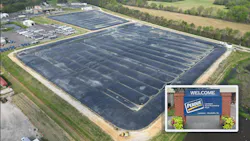
You Selected Perdue Farms-Lewiston
Every year, Food Processing solicits nominations from food & beverage processors for our Green Plant of the Year award, and then asks you, our readers, to vote for the plant that you believe deserves recognition.
This year, Perdue’s Lewiston, N.C., facility won our 16th annual Green Plant of the Year poll, besting very worthy plants from Ajinomoto Foods North America (its Portland, Ore., plant) and Gills Onions (Oxnard, Calif.). Our thanks to the 403 of you who read through the essays during the month of August and voted.
With headquarters on the Delmarva peninsula and numerous facilities and chicken suppliers throughout the Chesapeake watershed, it’s no surprise that Perdue Farms has deeply attuned itself to reducing its environmental impact.
This year, for our 16th annual Green Plant of the Year award, Food Processing honors Perdue Farms’ Lewiston, N.C., chicken processing plant for its holistic, multi-faceted approach to sustainability. Lewiston stands as a microcosm of what the company strives to achieve across its entire operations network, says Ben Hildebrand, director of environmental sustainability for Perdue Farms.
“We strive to be the most trusted name in food and agricultural products. To do that in 2026, we have to understand our impact on the ecosystems of the communities we’re working in,” he explains. “Our job is to be the innovator in the industry, to push the envelope, do better, and force the rest of the industry to follow us and demand better.”
The Lewiston facility reflects its parent company’s mentality, and it continues to successfully push for a place as an industry leader. In 2025, the U.S. Poultry & Egg Assn. awarded the Lewiston facility its 2025 Clean Water Award, given annually to poultry facilities that demonstrate exceptional performance in wastewater treatment, water reuse and overall sustainability, with winners selected by a committee of industry engineers and university experts.
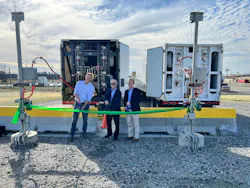
Lewiston treats approximately 2.4 million gallons of wastewater per day and earned the award predominantly for renewable natural gas (RNG) initiatives it started in 2022. The facility worked with a third-party company to cover two anaerobic wastewater lagoons on site in order to capture the methane that was being produced. The methane is then converted into RNG by equipment on site and sent into the natural gas supply.
The USPoultry award also factored in Lewiston’s work to purify byproduct carbon dioxide from the RNG production on site and convert it into liquid CO2, which is then used for both internal and external applications. These RNG initiatives have reduced greenhouse gas emissions at the facility by a whopping 99%.
Multiple opportunities
Although its RNG initiative stands out at first, at the Lewiston plant, sustainability isn’t defined by a single initiative.
“Years of continuous improvement and innovation,” the facility’s nomination says, have led to progress and high achievement in numerous areas.
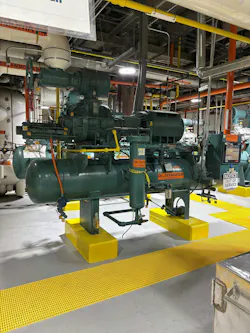
The facility demonstrated a 97% waste diversion from landfill rate in 2021, and employees have continued to drive further improvements in waste management. In 2024, the Lewiston plant replaced outdated fluorescent lighting with high-efficiency LEDs throughout key areas of the facility, leading to a reduction in electricity consumption in those areas of 67%.
Ashton Weller, environmental manager for the Lewiston complex, explains how the plant’s sustainability team contributes to these achievements.
“We have a cross-functional team of associates who are actively engaged in trying to find improvement opportunities across all sorts of areas, like electrical, water, air supply and waste management,” she says. “We’re actively looking for small projects because they add up to big environmental impacts.”
And the project list grew in 2025, when the Lewiston plant turned to reducing water consumption and identified an opportunity to conserve water in its offal department. The plant leaned on insights from its sister plant in Accomac, Va., which had embarked upon a similar initiative, and then configured a system to capture vacuum pump cooling and lubrication water and reuse it rather than send it down the drain. It is estimated that project is reducing annual water consumption by nearly 25 million gallons (or 3.4% of total harvest plant water usage).
Lewiston is not finished minimizing the impact it has on the environment and the company’s bottom line, especially given the culture that exists throughout the company and at the facility itself. In fact, Lewiston is already working on further reductions to its water usage, exploring more efficient nozzles and spray guns in the facility. Every little bit helps, and Weller says the employees are always on point when it comes to sustainability.
“Everybody has a role to play in sustainability, because it’s not just the big projects we do that matter,” she says. “It’s turning the light off when you walk out of the office or turning the water hose off — small things add up to big environmental impacts, and our employees know that.”
About the Author
Andy Hanacek
Senior Editor
Andy Hanacek has covered meat, poultry, bakery and snack foods as a B2B editor for nearly 20 years, and has toured hundreds of processing plants and food companies, sharing stories of innovation and technological advancement throughout the food supply chain. In 2018, he won a Folio:Eddie Award for his unique "From the Editor's Desk" video blogs, and he has brought home additional awards from Folio and ASBPE over the years. In addition, Hanacek led the Meat Industry Hall of Fame for several years and was vice president of communications for We R Food Safety, a food safety software and consulting company.