The Ongoing Evolution of Next-Gen Inspection and Detection
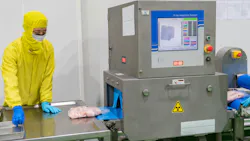
The food & beverage industry continues to battle foreign material contamination of the product stream, and technological innovation continues to feed processors the tools they need to continue to push back the enemy. Even as food & beverage recalls continue to make headlines for foreign material issues, there has been progress toward reducing the risk of product contamination.
“We're moving from reactive to predictive decision-making,” explains Juanfra DeVillena, senior vice president of quality assurance and food safety for chicken processor Wayne-Sanderson Farms. “Digital platforms provide real-time visibility into quality and food safety performance, while AI and machine learning technologies are creating new opportunities throughout our 23-plant operation.”
Many processors have begun to explore new technologies and even incorporate a multi-hurdle approach to finding foreign material and removing that contaminated product from the stream, says Jessica Evans, director of food advisory and training for NSF.
“Throughout the industry, we are seeing many food manufacturers transition from traditional metal detection systems to X-ray inspection technology,” she says. “Some facilities use both technologies, depending on product characteristics, hazard analysis and cost considerations.”
X-ray inspection has come into play, Evans says, because of its ability to identify materials such as glass, packaging defects, missing product units and a variety of other product non-conformances, beyond just metal contaminants. Furthermore, its use extends beyond the realm of food safety for some processors.
“In produce operations, for example, X-ray technology is being used not only for foreign material detection but for quality assessment, including evaluation of attributes including size, weight, color, bruising and other defects,” Evans notes. “These systems can then automatically sort products into designated processing streams based on predefined criteria.”
Next-gen inspection
Like many systems in food & beverage processing, data and subsequent analysis are driving innovation forward. According to DeVillena, Wayne-Sanderson has been able to transform its approach to quality assurance, food safety, sustainability and operational performance simply through leveraging data analytics to identify trends, mitigate risk and make informed decisions before a shift ends.
Smart inspection systems support processors’ compliance efforts even as operational technology improves. DeVillena points to AI and deep-learning vision systems, advanced X-ray and CT scanning systems and hyperspectral imaging as leading solutions for the industry.
In terms of the actual detection developments, advanced X-ray and CT systems use dual-energy imaging and density differentiation to detect bone fragments, glass, rubber and other contaminants, while hyperspectral imaging uses high-speed photography to analyze hundreds of spectral bands and identify unique material signatures, helping distinguish food from foreign materials regardless of color similarities.
Meanwhile, advances in AI and machine learning can take all those various images, translate the results into usable data, then analyze and react or suggest next steps to plant operators and maintenance — representing a new frontier for inspection and detection.
The next frontier
Although AI continues to evolve, and quite quickly in most cases, it is already delivering measurable results when it comes to inspection and detection, DeVillena says. In the wake of all this progress, processors will be able to alter their approach to foreign material prevention as well.
“The next frontier is moving from reactive containment to predictive prevention through multimodal AI, hyperspectral sensing and integrated digital food safety systems,” DeVillena says. “Additionally, broader plant connectivity through IoT sensor networks, predictive maintenance, automated traceability and digital compliance systems will continue transforming food safety programs from retrospective reporting to proactive risk prevention.”
Evans sees processors moving along this innovation spectrum already: “We are increasingly seeing processors seek inspection systems that not only detect foreign materials and quality defects but identify root causes and help prevent future occurrences,” she says.
Whereas technology decades ago likely prevented the identification of issues due to low sensitivity at the time, an additional modern-day challenge revolves around systems potentially being too sensitive or unable to differentiate between risks and non-issues all that well, Evans adds.
“A key challenge when moving from detection to prediction is achieving the right balance between sensitivity and accuracy,” she says. “Inspection systems must reliably identify risks while minimizing false positives that can result in unnecessary product waste and reduced operational efficiency.”
DeVillena agrees, saying “the primary drivers — stricter food safety requirements, increased production speeds and the need to reduce costly waste and eliminate recalls — demand solutions that improve detection accuracy while minimizing false positives and maintaining throughput.”
That’s a thin line on which to balance for many processors, but in the name of keeping consumers safe by removing dangerous foreign material from their food and beverage products, using innovative technology to tip toward the side of safety should always be the goal.
About the Author
Andy Hanacek
Senior Editor
Andy Hanacek has covered meat, poultry, bakery and snack foods as a B2B editor for nearly 20 years, and has toured hundreds of processing plants and food companies, sharing stories of innovation and technological advancement throughout the food supply chain. In 2018, he won a Folio:Eddie Award for his unique "From the Editor's Desk" video blogs, and he has brought home additional awards from Folio and ASBPE over the years. In addition, Hanacek led the Meat Industry Hall of Fame for several years and was vice president of communications for We R Food Safety, a food safety software and consulting company.