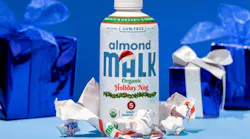
Small Companies Celebrate the Holidays

Consumers start encountering holiday-themed products on grocery store shelves as early as August these days, because major food manufacturers recognize the power of holiday shopping and have the logistics power to time their holiday offerings well.
But what about smaller producers who also want to benefit from holiday sales? Their timelines are generally shorter and their logistics are less sophisticated, but many still succeed at the holiday product game.
“Our seasonal collections include coffees for winter, summer, fall and holiday. Out of those four coffees, the holiday one far outsells the others,” says Emeran Langmaid, founder and vice president of operations for Rare Breed Coffee.
“As a consumable, coffee makes a great gift. Our holiday coffee, Sleigher, is very giftable in a memorable can that can be reused once the coffee is gone.”
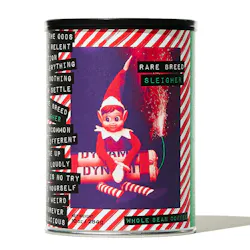
Rare Breed Coffee is a tiny player in the coffee world. Its slogan is “Coffee for people who give a sh*t about coffee,” and that concept is reflected in its “fusion roasted” blends of coffee – meaning complementary coffee bean varieties are roasted together, rather than blended after roasting, as is more common – as well as its funky, artistic steel cans.
Langmaid says her company launched Sleigher in 2023. She calls the blend a “project coffee,” which means it varies slightly year to year, though the company pursues a blend that hits a specific flavor profile, including a hint of chocolate and an elevated complexity. The label on the steel can, showing an “elf on the shelf” holding two sticks of dynamite, conveys a holiday feel with a provocative twist.
Sleigher’s sales make up 43% of the total sales of the company’s four seasonal blends. Langmaid says the holiday blend has been available in retail stores for the past two years.
“Our retailer partners can place pre-orders starting in August,” Langmaid says. “With that lead time, we have an idea of expected volume. Due to its holiday nature, we try to purchase just enough green to get us through mid-December. It’s always a little challenge, but with several years of history, we have a pretty good idea of our inventory needs.”
Although Sleigher is only three years old, Langmaid says the company has 25 years of roasting history to lean on when they are predicting inventory needs. Given the brief holiday selling season — and the fact that it drops off suddenly at the end of December — they are conservative when ordering the beans they’ll use for Sleigher.
What happens to left-over Sleigher once the holidays end?
“Because the holiday selling season has such a sharp cut off, any remaining cans are marked down,” Langmaid says. “Most buyers have a solid handle on how much to bring in. Sleigher makes such a great gift: It’s a consumable. It’s a great price point for gifting. It’s fun. Once the coffee is gone, it makes a useful holiday storage container.”

Holiday honey sweetens Q4 sales
Another small food producer that succeeds with a holiday version of its product is The Honey Truck Co., which sells a line of high-quality raw honey sourced from “ethically treated bees” in Florida. Best sellers include Raw Florida Vanilla Infused Honey and Orange Blossom Honey.
During the holidays, another best seller is Holiday Honey, which the company has offered each year since 2018. That variety accounted for 27% of the company’s sales in the fourth quarter of 2025, says Danielle Brooks, founder and beekeeper at The Honey Truck Co.
“I wanted to create a product that wasn’t just cinnamon, so I decided to add clove, nutmeg, rooibos, cinnamon and orange peels,” Brooks says. “I like to say it’s Florida Christmas in a bottle.”
The company, which sells honey through retailers across the U.S., starts taking pre-orders from wholesale buyers in early August. Holiday Honey hits shelves in the last week of September.
While big companies often rely on advertising to pump up holiday sales, Honey Truck relies on social media, emails to fans and public relations pitches to local news TV for segments on cooking and the health benefits of honey, Brooks says.
Social media is an effective tool for holiday product promotions, notes Stephen Dombroski, director of consumer products and food & beverage marketing for QAD, provider of manufacturing software. “Among Gen Z and Millennials, social media is now the No. 1 source of holiday gift inspiration. It is not a fringe channel. It is where demand is being created before your sales team even knows a category is moving.”
Brooks says she doesn’t worry much about retailers still having Holiday Honey on shelves after the season ends. There is always a limited amount of the honey and her wholesale customers are accustomed to ordering carefully, she believes.
“Anybody who has been a fan of the Honey Truck for any length of time knows that we release Holiday Honey every year and we only do a certain amount, so when we run out that’s it for the year. In a way this creates the demand,” Brooks says.
The holidays matter upstream, too
The holidays put pressure on food manufacturers to get product on shelves and into households during a small time window, but the holiday timing also affects suppliers of holiday-related ingredients.
For example, Wholesale Nuts and Dried Fruit sells nuts, dried fruit and seeds, some of which are important ingredients of holiday food items. About 25% of the company’s sales happen in November and early December, says CEO Matthew Baron.
Baron says his favorite holiday customer is Polashek’s Locker Service Inc., which makes a specialized Polish sausage that “sells like crazy during the holidays,” he says. Dried, diced pineapple from Baron’s company is the second ingredient.
“The holiday season creates a completely different set of operational realities compared to the rest of the year,” Baron says. “The issue for the businesses that I work with is that they all want fresh ingredients all at the same time. Most of my food comes from farmers in California. So, when the harvest comes in August, food starts to be put in freezers so it is ready to go out in October and November.”
It’s even more complicated than it sounds. Baron explains that walnuts, for example, are rich with oil around the nut when they are harvested, and that oil is essential to the flavor and texture. Thus, the shells can’t be removed in August, when the nuts are harvested, because food processors want the freshest walnuts possible, as they’re making their holiday products right before demand peaks.
“You have to break the shells in October and November so that customers get freshest walnuts in their oil,” Baron says. “Today, the refrigerated rooms are massive to store all the walnuts for the fall, winter and spring. Plus, they had to stay cold in one of the hottest summers on record in California in 2026.”
Then the walnuts and other ingredients need to reach the food processors on precisely the schedule they create. The ingredients can’t arrive early or late – early arrivals take up storage space and late arrivals throw off production schedules.
“Every year I get those calls about Fed Ex being late and ‘We needed that ingredient on November 16th exactly or everybody is in big trouble,’” Baron says. “Also, companies don’t want over- or late production because they have to pay to store it. Or store it at Amazon or Walmart warehouses, which is even more expensive.”
Despite the challenges, Baron seems to view his company’s work as more than just a profit venture: “I am the furthest down the chain. My work is with fresh food ingredients. So, I do my best to protect the farmers and the processors and help all the American small businesses I can over the next few months.”